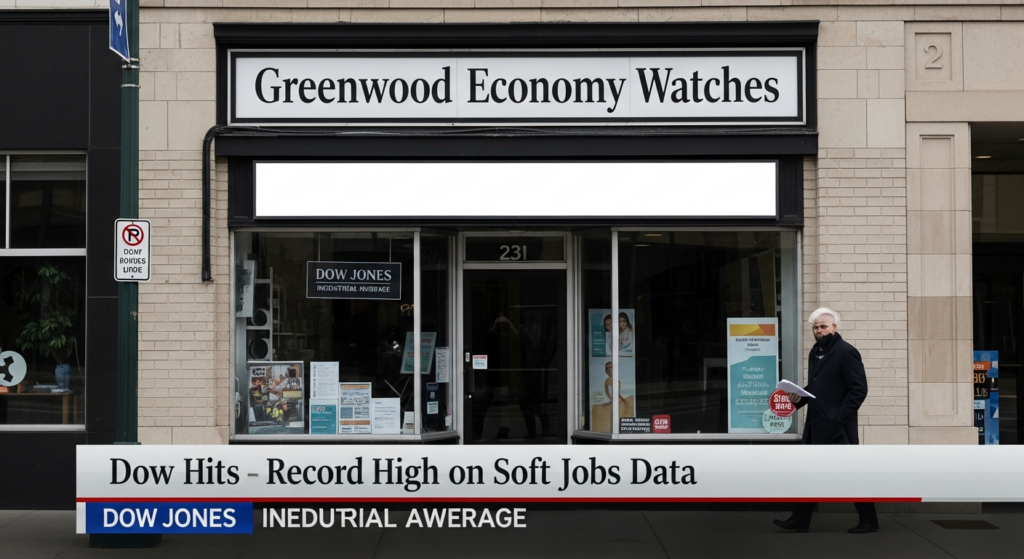
The Dow Jones Industrial Average closed at a record high this week, a market reaction primarily driven by June payroll growth figures that came in below economists’ estimates. This unexpected softening in the national job market has prompted investors to recalibrate their expectations for future Federal Reserve interest rate decisions, suggesting a potential shift in monetary policy.
The national jobs report indicated a slower pace of hiring than anticipated, a development that often signals a cooling economy. While a robust job market is generally seen as positive, a slight deceleration can sometimes be interpreted by financial markets as a sign that inflationary pressures are easing, potentially giving the Federal Reserve more leeway to consider interest rate adjustments. Investors are closely watching these signals, weighing renewed equity inflows and sustained demand in the technology sector against the backdrop of this payroll caution, particularly as the nation observes the July 4 holiday weekend.
For a city like Greenwood, national economic trends, though seemingly distant, often translate into tangible local impacts. The performance of major market indices like the Dow, and the underlying economic data that drives them, can influence everything from the cost of borrowing for local businesses to the investment portfolios of individual residents and the financial health of key institutions.
Greenwood’s economy is anchored by several significant sectors and employers, each sensitive to broader economic shifts. Self Regional Healthcare, the city’s primary industry employer, for instance, operates within a complex financial environment where interest rates can affect capital expenditures for new facilities or technology upgrades. A national economic slowdown, or the prospect of lower interest rates, could influence patient volumes, insurance reimbursement rates, and the overall cost of providing care, potentially impacting the hospital’s operational strategies and hiring needs within Greenwood.
Similarly, the education sector, represented by institutions like Lander University and Piedmont Technical College, is not immune. Endowment performance, which can be tied to stock market fluctuations, helps fund scholarships and academic programs. Changes in the national economic outlook can also affect student enrollment patterns, particularly for workforce development programs at Piedmont Technical College, as individuals weigh educational investments against job market prospects. Lower borrowing costs, should the Federal Reserve act, could also make infrastructure projects or student loan burdens more manageable.
Greenwood’s advanced manufacturing base, including companies such as Eaton Corporation, Lonza (Capsugel), Carolina Pride Foods, and Cardinal Health, also feels the ripple effects of national economic data. These employers rely on stable consumer demand, efficient supply chains, and access to capital for expansion and modernization. A national slowdown in hiring or consumer spending could lead to adjustments in production schedules or investment plans, directly affecting employment opportunities and economic activity in Greenwood. Conversely, an environment of lower interest rates could incentivize these companies to invest in new equipment or expand operations, fostering local job growth.
The broader implications extend to the daily lives of Greenwood residents. Fluctuations in the stock market can impact retirement savings and investment portfolios. Shifts in Federal Reserve policy, particularly regarding interest rates, directly influence mortgage rates, car loans, and credit card interest, affecting the purchasing power and financial planning of households across the city. A national economic climate that suggests potential rate cuts could offer relief to borrowers and stimulate local consumer spending, while uncertainty can lead to caution.
As investors continue to analyze the interplay between employment data, inflation, and monetary policy, the national economic narrative remains a critical factor for local planning and individual financial decisions. The record close of the Dow, spurred by a nuanced jobs report, underscores the interconnectedness of global markets and the local economies they ultimately influence.
### Why it matters in Greenwood
The recent market movements and the underlying economic data have direct implications for Greenwood’s economic landscape. For institutions like Self Regional Healthcare and Lander University, potential shifts in Federal Reserve interest rate policy could influence their ability to secure favorable financing for future expansion projects or manage existing debt. A national environment signaling lower rates might make capital investments more attractive, potentially leading to facility upgrades or program enhancements that benefit the broader Greenwood community. Furthermore, the overall economic sentiment driven by these national figures can affect local consumer confidence, impacting retail trade and the financial well-being of residents who are employed by or served by these cornerstone Greenwood institutions.